Los Angeles
The Reincarnationist PapersLos Angeles gives Evan Michaels a place to disappear among people who, like him, may be living several lives at once. He comes seeking himself after memories begin returning, but the city offers no simple refuge: its anonymity shelters him, while its hotels, bars, derelict buildings, and back streets make survival contingent and uneasy.
Arrival and Anonymity
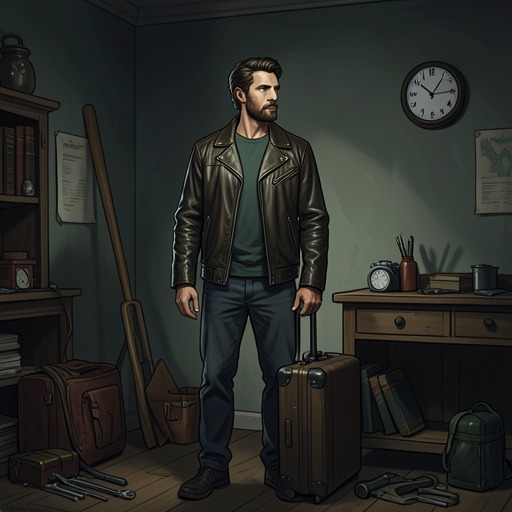
Evan left Minnesota three years before the events in Los Angeles because he had started to remember. He describes his departure as a search for himself, one that brought him not to a settled identity but to a city where nobody is exactly what they seem. In his account, a doctor may also be an art collector, a student may be preparing for an audition, and a salesman may be writing a screenplay. The point is not that these hidden ambitions make the city transparent; it is that being more than one thing allows a person to remain anonymous. Los Angeles suits Evan because its residents’ layered lives give his own concealed past a social setting in which it need not immediately stand out.
That fit is practical as well as inward. Evan has begun to recover memories he cannot simply set aside, yet the city does not require him to explain himself to everyone he meets. Los Angeles becomes a place to look for an identity while postponing any settled account of it. The same quality that attracts him also leaves him isolated: anonymity can provide cover, but it does not guarantee security or belonging.
Temporary Shelter and Nightlife
Evan has lived at the Ohio Hotel for five months, in conditions that make his foothold in the city visibly fragile. If he falls even a day behind on the weekly rent, management puts a blue, spray-painted padlock on his door. If he does not pay by the end of the week, his possessions will be removed along with the lock. At one point he has been shut in his room for three days, aware that the management will not padlock the door from the outside while someone remains inside. When he finally leaves, he passes the front desk as staff search a drawer for the lock. He still has four days before the threatened removal of his belongings, but the room already feels less like a secure home than a short reprieve.
The city’s night offers a different kind of temporary refuge. On a muggy evening, with the temperature still in the low nineties and no wind, Evan walks through downtown Los Angeles amid the smells that hang in the air. He is heading to the Necropolis Club, where a line has formed outside; a bouncer lets him in without waiting. The club has been his preferred bar for a year, though a newspaper write-up has brought amateur patrons from Simi Valley and Chino. Its new popularity has not changed the room itself.
The Necropolis Club
The Necropolis occupies an old movie theater, converted by removing the seats, leveling the floor, placing bars along the front and back walls, and building a stage before a large silver screen. Silent black-and-white films play behind the bands. Blue-white neon shines beneath thick frosted-glass bar tops, lending the drinks a blue glow, while the stripped and black-painted walls carry towering white bas-relief portraits of Egyptian gods. The room’s distinctive spectacle sits inside a repurposed theater: the old screen remains, but it now frames live music rather than a conventional film audience.
For Evan, the club is also a point of contact. He arrives at 10:45 to meet Martin at midnight and finds Henry behind the bar, greeting him by name. The familiar bartender and the seat Evan takes at the back bar make the club more than an anonymous nightspot; it is one of the places where his life in Los Angeles has acquired routine and recognizable connections. That routine, however, does not remove the pressure of his precarious lodging or the danger developing elsewhere in the city.
Warehouses, Flight, and the City’s Back Side
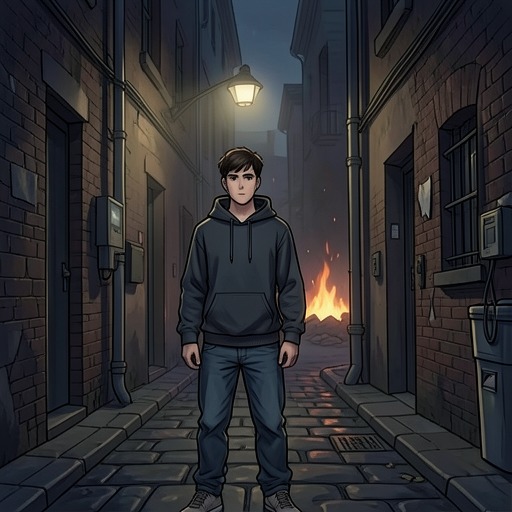
Martin’s warehouse stands in a different Los Angeles from the crowded club. Its neighborhood is strewn with garbage and broken window glass, and only one in every four or five buildings appears occupied. Evan finds the address by counting down numbers on door frames and transoms. The warehouse is a two-story brick building, last painted gray, with four tall, narrow, intact windows on the street-facing upper floor. Two large picture windows have been boarded over; the plywood has weathered to nearly the same gray as the paint, stained by smog-soiled rain. At the rear, a floodlight from an occupied warehouse halfway down the alley throws long shadows.
The entrance is a broad, heavy metal door, four feet wide and eight feet high, reinforced with horizontal riveted steel straps. It seems more suited to a prison than a warehouse. Evan uses a discarded newspaper to cover the handle, inserts the key into the dead bolt, and turns it without noise. The care he takes to avoid leaving fingerprints makes the building part of a clandestine undertaking, not merely a location on his route through town.
After the fire and his escape, Evan reaches a church at the back of a stairwell. Fourteen concrete steps lead up to street level, beneath a high wall of rough-cut limestone; dim light inside makes the stained-glass windows glow green, red, and yellow. He has been shot in the heel, cannot walk, and is surrounded by bloodied newspapers and a crushed cigarette pack. The church is a place to hide, but not a safe resolution: Evan weighs the need for medical help against the risk that a police report will connect him to the arson.
Narrative Significance
Los Angeles holds opposing forms of concealment. The club lets Evan blend into a crowd of people with private ambitions; the Ohio Hotel makes clear how little protection his city life affords; the warehouse and church turn its neglected edges into a route through danger. The city does not solve the problem of Evan’s returning memories. Instead, it gives that private crisis an urban shape: a search for self conducted under cover, amid unstable shelter and the immediate need to escape notice.